

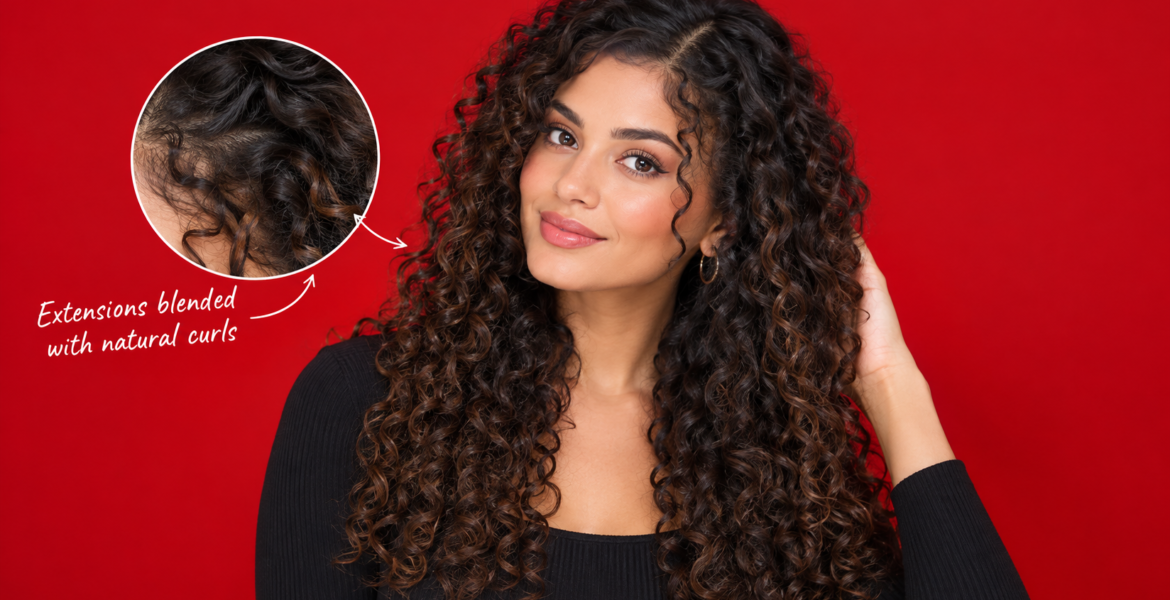
Curly Hair Extensions: The Complete Guide to Choosing and Wearing Them
Finding curly hair extensions that actually blend, rather than sitting obviously on top of your natural hair, is harder than it looks. Straight extensions are everywhere. Genuinely well-matched curly ones take a bit more knowledge to get right. This guide covers the different types of curly hair attachments, how to match your curl pattern properly, and how to wear extensions so they move and behave like your own hair.
What Are Curly Hair Extensions?
Curly hair extensions are wefts or strands of hair, either human or synthetic. They come pre styled into a curl pattern rather than left straight. They attach to natural hair using various methods. This adds length, volume, or both, while matching the texture of curly or coily hair types. Unlike straight extensions, these come pre curled. This helps them blend more convincingly and reduces daily styling effort.
Types of Curly Hair Attachments
The attachment method matters just as much as the curl pattern itself. Each type suits different hair types, budgets and how often you plan to wear extensions.
| Attachment Type | How It Works | Best For | Typical Wear Time |
|---|---|---|---|
| Clip in | Small wefts clip directly onto natural hair | Occasional wear, beginners | A few hours, removed daily |
| Tape in | Thin wefts taped close to the scalp | Semi-permanent, low maintenance styles | 6 to 8 weeks |
| Micro link | Small silicone lined rings attach individual strands | Fine or thin natural hair | 2 to 4 months |
| Sew in weave | Hair braided into cornrows, wefts sewn on | Thicker natural hair, longer wear | 6 to 8 weeks |
| Keratin fusion | Keratin bonds fused to small hair sections with heat | Natural looking, long term wear | 3 to 4 months |
Clip ins are the easiest starting point if you are new to curly hair extensions. They need no professional application and can be removed each night. Tape-ins and micro links tend to sit more naturally against curly roots. They add less bulk than a sewn in weft.
How to Match Your Curl Pattern
This is where most curly hair extensions go wrong. A curl that is too loose or too tight creates an obvious, mismatched line. This happens no matter how good the attachment method is.
Curl patterns are generally grouped into loose waves, defined curls, and tight coils. Loose waves suit hair with a gentle S shape and minimal shrinkage. Defined curls suit hair with springy, well formed ringlets and moderate shrinkage. Tight coils suit hair with a Z shaped pattern and significant shrinkage when dry.
Buy extensions labelled by curl type, rather than a generic description like “curly.” This gives a far better chance of an accurate match. If possible, compare the extensions against your hair in natural daylight before committing. Curl pattern can look different under artificial lighting.
Choosing Between Human Hair and Synthetic Curly Extensions
Human hair extensions cost more. They behave far more like natural hair. They can usually be washed, styled, and occasionally heat treated to refresh the curl pattern. Synthetic curly extensions are cheaper. They hold their shape well initially, but cannot withstand heat styling and lose their pattern faster with wear.
For regular wear, human hair is generally the better long term investment. It holds up to washing and restyling without the curl pattern flattening out.
How to Wear Curly Hair Extensions Naturally
A few small techniques make a noticeable difference in how convincingly curly hair extensions blend in.
Section your natural hair before attaching wefts or clips. Work from the bottom layers upward, so extensions sit hidden underneath your own curls. Twist or finger coil the natural hair closest to each attachment point. This blends it gently with the extension’s curl pattern. Avoid brushing curly extensions with a standard brush. This can loosen the curl definition. A wide tooth comb or simply finger detangling works far better.
Colour Matching Curly Extensions
Getting the curl pattern right matters, but colour match matters just as much for a convincing blend. If your natural hair colour sits between two shade levels, choose slightly lighter rather than darker. Extensions can be toned down more easily than lightened. For a clearer sense of how hair colour levels and undertones work, our hair colour chart guide breaks down exactly how to read shade numbers before you buy.
Caring for Curly Hair Extensions
Curly extensions need slightly different care than straight ones to keep their pattern intact. Wash less frequently than you might with natural hair. Overwashing can loosen curl definition over time, particularly with human hair extensions. Use a sulphate free shampoo and a rich conditioner. Apply conditioner mid length to ends rather than at the attachment points. Air dry when possible, or diffuse on a low heat setting. High heat can damage both human hair and synthetic fibres.
Detangle gently while the hair is damp and coated in conditioner. Work from the ends upward in small sections to avoid pulling or shedding.
Frequently Asked Questions
Do curly hair extensions work on all hair types?
Yes, provided the curl pattern and attachment method are matched to your natural hair type. Fine or thin hair generally suits lighter attachment methods like tape ins or micro links, while thicker hair can carry heavier methods like sew in wefts more comfortably.
How long do curly hair extensions typically last?
This depends on the attachment method and hair quality. Clip ins can last years since they are removed daily. Semi-permanent methods like tape ins need reapplication every 6 to 12 weeks.
Can you restyle curly hair extensions if the curl loosens?
Human hair extensions can usually be re curled using a curling iron or perm rods on low heat. Synthetic extensions generally cannot be heat restyled. They may need replacing once the curl pattern relaxes.
