

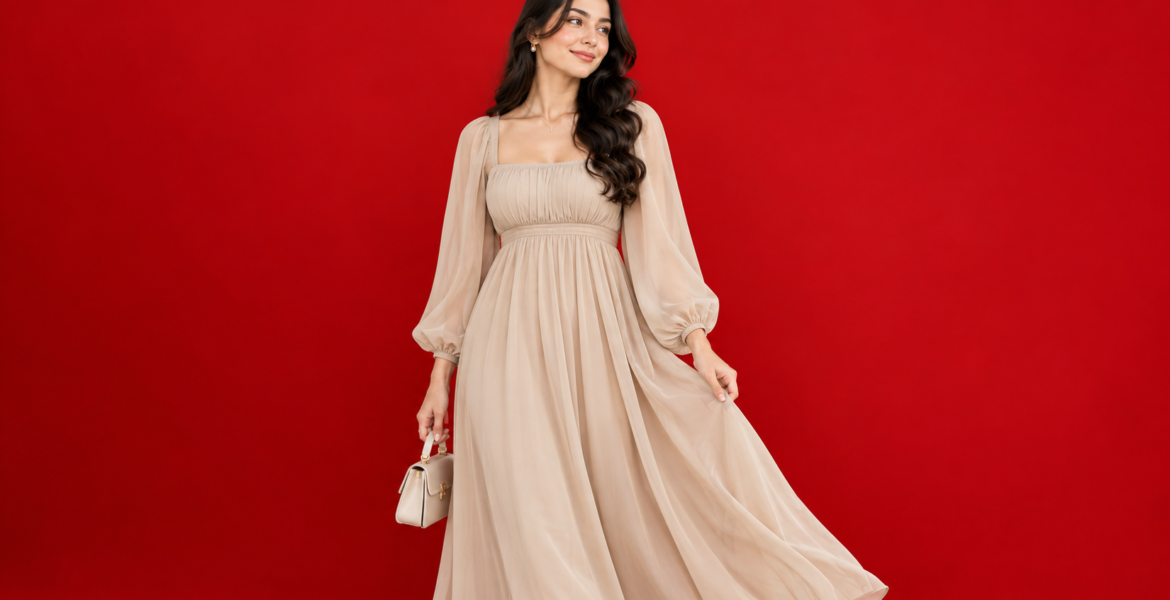
What Is an Empire Waist? Dress Guide and Styling Tips
An empire waist is one of those dress details that quietly does a lot of work. It rarely draws attention to itself. The waistline sits high, gathered directly under the bust rather than at the natural waist. The rest of the fabric falls in a soft, uninterrupted line to the hem. It shows up constantly in empire waist dresses, from bridesmaid gowns to everyday summer dresses. It flatters a wide range of body shapes. This guide covers what actually defines the empire waistline, how it differs from an empire neckline, and how to style it.
What Defines an Empire Waist?
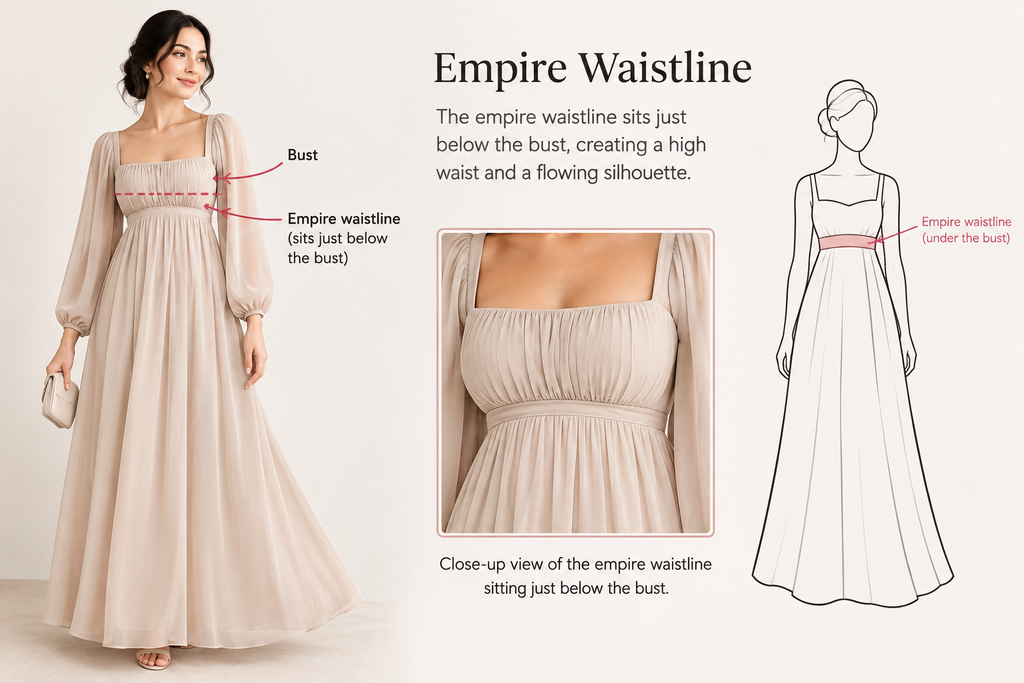
The empire waist gets its name from a specific seam placement. It is not about the shape of the skirt or the neckline above it. The defining feature is simple. The waist seam sits just below the bust, well above where a natural waistline normally falls.
| Feature | What It Looks Like |
|---|---|
| Waist seam placement | Directly under the bust, not at the natural waist |
| Skirt shape | Flows loosely from the seam down to the hem |
| Overall silhouette | Long, vertical line rather than a fitted middle |
| Common fabrics | Chiffon, silk, jersey, lightweight cotton |
Because the seam sits so high, the fabric below it moves freely. This gives empire waist dresses their soft, flowing character, rather than the fitted shape seen in a sheath or bodycon style.
Empire Waist vs Empire Neckline: They Are Not the Same Thing
This is worth clarifying, since the two terms get mixed up often. An empire waist refers to where the dress is seamed, high, under the bust. An empire neckline refers to a different part of the garment entirely, the shape and cut of the neckline itself. It is typically rounded or gently scooped, sitting close to the collarbone.
The confusion happens because the two frequently appear together on the same dress. A classic empire style often pairs a high waist seam with a rounded neckline. The two echo the same soft, uncomplicated shape. They can also appear separately. A dress can have an empire neckline with a fitted, natural waist. Equally, an empire waist can pair with a V-neck or square cut instead. Knowing the difference matters if you are shopping for one feature specifically, rather than assuming the two always come as a pair.
A Brief History of the Empire Waist
The style takes its name from the First French Empire, the period surrounding Napoleon Bonaparte’s rule in the early 1800s. It marked a deliberate move away from the heavily boned corsets that had shaped women’s fashion for the preceding century. Inspired by the draped garments of ancient Greece and Rome, the raised waistline offered a lighter, more comfortable alternative. It still read as elegant.
Empress Joséphine, Napoleon’s wife, became closely associated with the look. She helped popularise it across Europe during the Regency era. The silhouette has resurfaced repeatedly since then, appearing in various revivals through the following two centuries. It remains a recognisable, wearable style today, not a purely historical curiosity.
Why Empire Waist Dresses Suit So Many Body Shapes
The high seam does more work than it might seem. By placing the narrowest visual point under the bust, rather than at the natural waist, the dress creates length through the lower body. This works regardless of where someone naturally carries weight or curve.
For petite frames, this elongating effect is particularly useful. The flowing skirt visually extends the leg line and can make someone appear taller than a dress fitted at the natural waist. For pear or apple shapes, the loose fabric below the seam skims rather than clings. It offers ease through the hip and midsection without looking shapeless. For straighter or more athletic frames, the gentle gathering under the bust adds a soft curve. This softens a frame that might otherwise read as quite linear.
How to Style an Empire Waist Dress
For daytime or work settings, a midi length empire waist dress in cotton or linen reads as polished rather than casual. Adding a tailored blazer introduces structure to balance the dress’s naturally soft shape. Block heels or loafers keep the look grounded and office appropriate.
For evening or formal occasions, a floor length empire waist gown in silk, satin or chiffon shifts the same silhouette into something more dramatic. Since the dress carries a simple, clean line, this is one of the few styles where bolder jewellery genuinely works. A statement necklace or drop earrings will not compete against the outfit.
Choosing the Right Fabric
Fabric changes the entire character of an empire waist dress. Soft, flowing materials like chiffon, silk or jersey create the classic, romantic drape most people associate with the style. They move gently with the body rather than holding a fixed shape. Firmer fabrics, cotton, linen or a lightweight taffeta, hold more structure. They give the same silhouette a cleaner, more modern feel. Neither is objectively better. The right choice depends on whether you want something soft and fluid, or crisp and considered.
Does an Empire Waist Dress Make You Look Pregnant
This is a common concern, and it usually comes down to fit rather than the style itself. A well-fitted empire waist dress, particularly one made from a fabric with drape, skims the body rather than adding bulk. The issue tends to arise when the fit under the bust is too loose. This allows the fabric to balloon outward, rather than fall in a clean line. Choosing a dress that fits snugly through the bust, where the seam actually sits, generally avoids this entirely.
Empire Waist vs A-Line: What’s the Real Difference
Both styles are popular because they flatter a wide range of shapes, but the waist placement is what separates them. An empire waist sits high, under the bust. Fabric falls in a straight, columnar line from that point down. At the opposite end of the spectrum sits a drop waist dress, where the seam drops to the hip instead of rising to the bust. An A-line dress keeps the seam at the natural waist, then flares gradually outward toward the hem. This creates the classic triangular “A” shape. The empire waist tends to elongate the body more dramatically. An A-line creates more visible shape and movement through the skirt itself.
Aline Empire Waist Dresses: When the Two Styles Combine
The empire waist and the A-line are not mutually exclusive. Many dresses borrow the best of both, and this hybrid is often searched simply as an a-line empire waist dress. The seam still sits high under the bust, as it does on a true empire style. From that seam, the skirt flares gradually outward rather than falling in a straight column.
The result is a dress that elongates the torso in the same way a classic empire waist does, while adding a little more shape and movement through the skirt. It works especially well for anyone who likes the empire silhouette but finds a fully straight skirt too plain. It also suits anyone who wants a little more volume for a wedding or formal event.
This combination tends to suit the same range of body shapes as a standard empire waist, since the high seam is still doing most of the flattering work. The added flare simply gives the skirt a bit more presence. It is worth checking where the flare begins. A gentle flare starting just below the seam keeps the elongating effect intact, while a wider flare lower down shifts the dress closer to a true A-line in feel.
